About Course
BPMN 2.0 is a standardized method for visually modeling business processes. It helps organizations document, analyze, and improve how work flows across teams and systems.
Delivered Live Online via Microsoft Teams, this program moves beyond abstract notation to focus on how BPMN is actually applied in real business environments. You will learn to create process models that are not just syntactically correct, but genuinely useful for decision-making, digital transformation, and automation.
What Will You Learn?
- Create BPMN 2.0 Diagrams: Master standard notation to document processes in a clear, structured, and standardized way.
- Model Real Business Workflows: Build structured diagrams that reflect real organizational contexts and avoid common modeling traps.
- Support Communication & Decision-Making: Use process maps as a clear communication tool across cross-functional teams and stakeholders.
- Prepare Processes for Automation: Design workflows that are ready for RPA, digital transformation, and system integration.
- Identify Process Inefficiencies: Pinpoint bottlenecks, redundancies, and improvement opportunities directly within process flows.
Audience
- Business analysts, process analysts, BPM practitioners, operations professionals, and anyone needing to clearly model, communicate, and improve workflows.
Requirements
- Designed for professionals expected to lead complex, cross-functional projects and mentor Green Belts. Prior knowledge of process improvement fundamentals or Green Belt completion is recommended.
A course by
- Alexandra Niculae
Material Includes
- Official ILSSI Accredited Learner Workbook & Reference Guide
- Live Online Interactive Training via Microsoft Teams
- Hands-on Process Modeling Exercises & Real-World Case Studies
- Expert Feedback on Your Own Process Diagrams
- Official ILSSI Examination Voucher
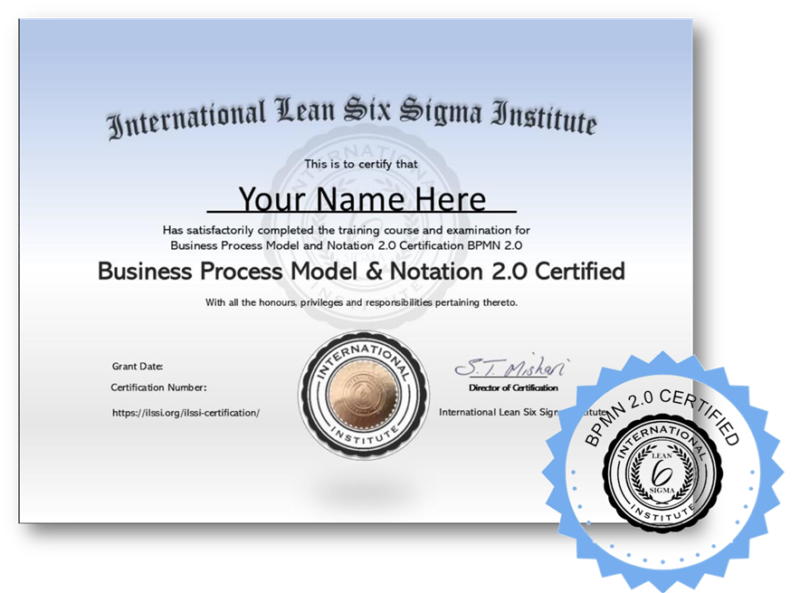
- Digital Certificate of Completion upon passing
Course Content
Module 1: Introduction & Core Elements
- What is BPMN 2.0 (history, purpose, benefits)
- Overview of BPMN diagrams (process, collaboration, choreography, conversation)
- Core Elements:
- Flow Objects: Events, Activities, Gateways
- Connecting Objects: Sequence Flow, Message Flow, Associations
- Swimlanes: Pools & Lanes
- Artifacts: Data Objects, Groups, Annotations
Module 2: Modelling Activities
- Activities in depth: Tasks (User, Manual, Service, Script, Send/Receive, Business Rule)
- Sub-processes (embedded, reusable, event sub-processes, transactions)
Module 3: Modelling Events
- Events in depth:
- Start Events (None, Message, Timer, Conditional, Signal, Multiple)
- Intermediate Events (Message, Timer, Error, Escalation, Compensation, Link)
- End Events (Terminate, Error, Escalation, Signal, Message)
- Exercise: Build a process model with multiple start and intermediate events
Module 4: Gateways & Collaboration
- Gateways in detail: Exclusive (XOR), Inclusive (OR), Parallel (AND), Event-based, Complex
- When and how to use gateways effectively
- Collaboration Modelling:
- Pools & Lanes for responsibilities
- Message flows between participants
- Choreography and Conversation Diagrams
Module 5: Advanced Patterns & Real-World Application
- Advanced Modelling Patterns:
- Exception handling (boundary events, escalations, error handling)
- Compensation flows (undoing work)
- Exercise: Model a customer complaint process with escalations and exception handling
- International Examination Preparation